

Data centers enter the battlefield
AI infrastructure is turning West Asia into a frontline of great power rivalry.
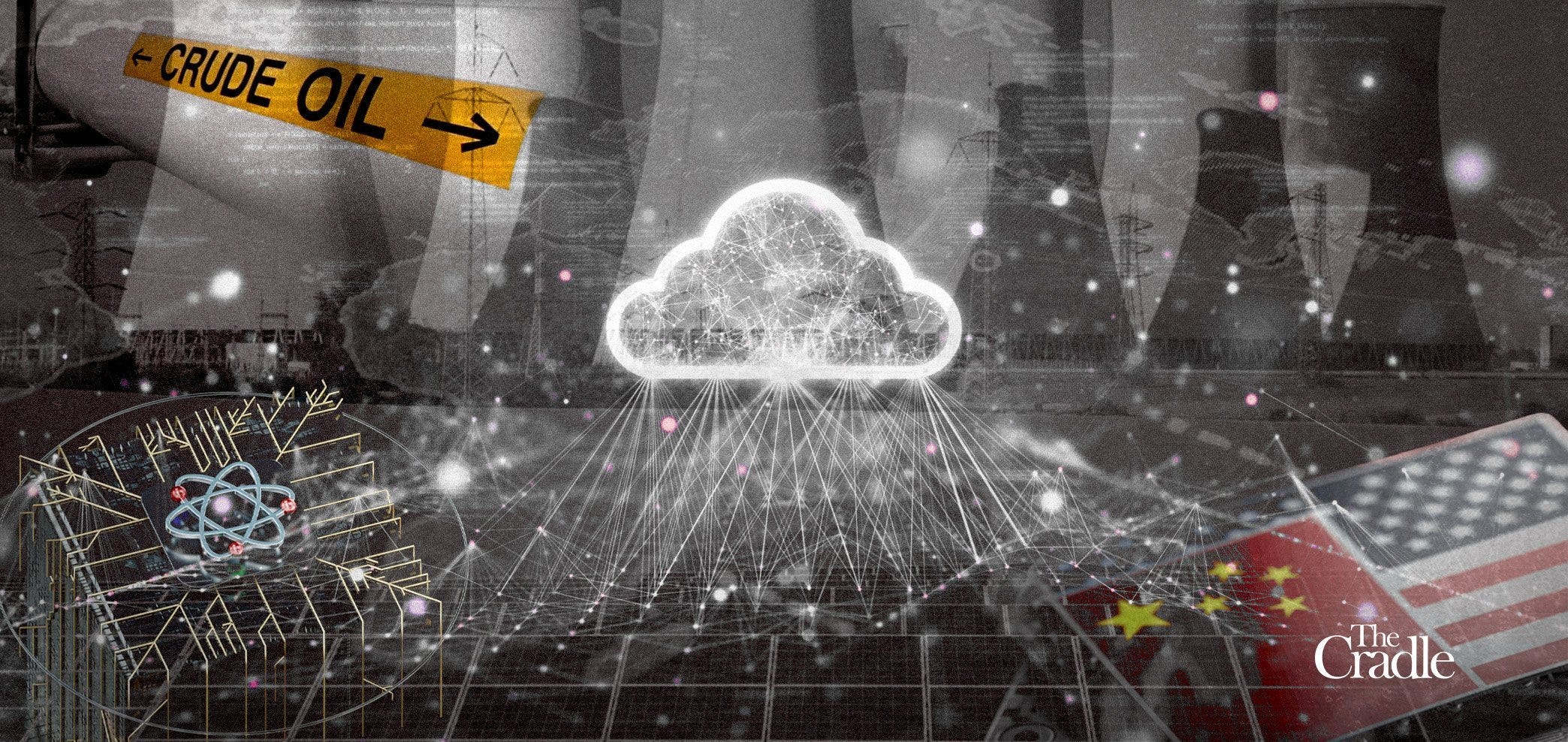
Editor’s note: This article was originally published on The Cradle website and is republished here for Substack readers.
For decades, wars in West Asia revolved around familiar strategic targets: air bases, naval facilities, oil terminals, and the maritime chokepoints that carried much of the world’s energy supply. Military planners understood that control over these assets shaped the regional balance of power.
The latest US-Israeli war on Iran points to another layer of infrastructure entering that equation.
As missiles crossed the skies across multiple fronts, attention centered on air defenses, retaliation, and the risk of escalation. Yet beneath the visible battlefield, another strategic contest was becoming increasingly apparent.
Where infrastructure becomes strategic
Governments, financial systems, intelligence services, and modern armed forces now depend on an invisible network of digital infrastructure that processes enormous volumes of data and increasingly supports artificial intelligence (AI).
Data centers – the low-profile buildings filled with servers that most people rarely notice – are moving into that space. Until recently, they were viewed largely as commercial facilities supporting cloud computing and digital services.
Today they are evolving into critical infrastructure for economic continuity, state administration, and elements of military decision-making.
Even energy policymakers are adjusting to that change. As Fatih Birol, executive director of the International Energy Agency (IEA), noted in 2024: “There is no AI without energy – specifically electricity.”
AI does not rest on software alone. It depends on electricity, data centers, semiconductors, and communications networks. Control over these systems has strategic consequences.
In the 20th century, oil shaped geopolitics by powering industry, transport, and war. Today, computational capacity is moving into a comparable role. AI systems rely on uninterrupted electricity, hyperscale data centers, fiber connectivity, and high-performance computing.
That change is pulling West Asia into sharper focus in the global race over AI. The region combines energy resources, sovereign wealth, state-led investment, and a position linking Europe, Asia, and Africa. Electricity has become central to AI, and that reinforces the value of advantages the region already holds.
Consequently, West Asia is rapidly becoming one of the principal arenas where the future architecture of global AI infrastructure will be shaped.
A new contest over computing power
AI has opened another front in great-power competition. Past rivalries focused on sea lanes, oil, and industrial capacity. The current phase turns on who builds, finances, and secures the systems that make AI possible.
That is where data centers come in.
They no longer sit on the margins as anonymous server farms. They support economic resilience, technological capacity, intelligence work, and aspects of national security. Influence now follows the ability to store, process, and move data at scale.
West Asia has become a focal point for this investment. Compared to Europe, energy is more readily available. Compared with many developing economies, Persian Gulf states can fund large-scale infrastructure.
The region also sits across key routes linking three continents. These conditions have drawn in global technology firms alongside governments.
For Washington, leadership in AI is tied to its wider technological position. Data centers, semiconductor supply chains, cloud systems, and digital partnerships are folded into that approach.
West Asia offers the conditions for AI expansion
When the UAE created its new Artificial Intelligence and Data Authority last month, Prime Minister Sheikh Mohammed bin Rashid said: “Our goal is a government that is faster, smarter and always one step ahead, one that uses technology to serve people and build a better future for the next generation.”
Speaking at this month’s UN Global Dialogue on Artificial Intelligence Governance in Geneva, UAE Minister of State for Artificial Intelligence Omar Sultan al-Olama said that “artificial intelligence has become far more than a technological advancement,” pointing to its growing role in how states make decisions, deliver services, and structure future development.
China is moving along a different track. Rather than alliances, it has expanded through infrastructure tied to the Digital Silk Road. Ports, telecom networks, fiber cables, and smart city projects have all played a role.
A more competitive global order is taking shape. For years, the digital ecosystem has largely formed around US companies and standards. That dominance is facing pressure as Chinese-backed infrastructure expands alongside it in parts of West Asia.
The competition no longer sits within technology alone. It reaches into the systems that support it. Which cloud platforms states rely on, which semiconductor networks supply industry, and which cybersecurity standards shape networks all carry weight. Control over infrastructure extends power beyond the technical sphere.
These questions will define the next phase of geopolitical competition – and West Asia is no longer observing that competition from the sidelines.
The next layer of conflict
The strategic value of data centers lies in what they support. They process financial flows, sustain public services, enable military communications, and feed into intelligence and logistics systems. Much of the functioning of the modern state passes through them.
As Kaveh Madani, Director of the UN University’s Institute for Water, Environment and Health, recently observed: “The public debate still often treats AI as software, but AI is also physical infrastructure: data centers, electricity generation, cooling systems, transmission networks, chips, minerals, land and water.”
In that light, their role now sits alongside other forms of critical infrastructure.
This changes the logic of conflict. For decades, military planners sought to weaken adversaries by targeting airfields, ports, bridges, oil facilities, and power stations. Increasingly, future conflicts may also seek to disrupt the digital infrastructure that enables governments, financial systems, and military organizations to function.
The objective would not necessarily be physical destruction. It could instead be strategic paralysis – interrupting the computational capacity on which modern states increasingly depend.
The recent war offered an early indication of this transformation. While missiles dominated international headlines, the confrontation also exposed how deeply modern societies rely on uninterrupted digital infrastructure.
AI is becoming integrated into intelligence analysis, logistics, command-and-control systems, cybersecurity, and public administration. As that dependence grows, protecting data centers may become as strategically important as protecting energy infrastructure.
For Gulf states, this creates a new strategic dilemma. The same countries seeking to become global hubs for AI investment must also prepare to defend the infrastructure that makes those ambitions possible. Building hyperscale data centers is only the first challenge; ensuring their resilience during geopolitical crises may prove considerably more difficult.
Future competition will therefore extend beyond investment incentives and technology partnerships. It will increasingly involve cybersecurity, physical protection, energy resilience, supply-chain security, and regional stability. The economics of AI can no longer be separated from the geopolitics of security.
West Asia’s strategic moment
Looking only through the lens of US–China rivalry understates the role of regional actors. Unlike earlier technological shifts, states in West Asia are not passive hosts. They are attempting to shape outcomes.
Saudi Arabia, the UAE, Qatar, Turkiye, and Iran all recognize that AI infrastructure represents more than technological modernization. It is becoming a strategic asset capable of generating economic diversification, geopolitical influence, and long-term technological sovereignty.
The change opens space for a different role. Rather than remaining exporters of energy, regional states are positioning themselves as producers of computational capacity. That ambition depends on investment, but also on developing local expertise, building research capacity, and protecting infrastructure over time.
What matters is how the broader system takes shape, and who holds influence within it.
A new geography of power
For much of the past century, West Asia’s importance rested on oil fields, pipelines, ports, and chokepoints. Those remain central, but they no longer capture the full picture. A parallel layer is taking form, built on electricity, networks, and computational systems.
Data centers are part of that change. Not as replacements for military or energy infrastructure, but as additions that underpin both. Their role sits in the background, yet it feeds into state capacity, economic stability, and military function.
The contest around AI will not be decided by software alone. It will hinge on who builds and secures the infrastructure that allows those systems to operate.
Across West Asia, that process is already underway. The region still supplies energy to the global economy. It is also starting to host the systems that support a different kind of power.
If earlier eras were shaped by competition over oil, the current phase is moving toward competition over computation. How that plays out will depend in part on what is being built now, and where.
Written by Kamran Yeganegi
This is a scary but realistic article. For those who are interested, they have a big Achilles' heel : cut their electricity supply.